Free Ebook How to Measure Anything: Finding the Value of Intangibles in Business
While the other individuals in the store, they are not exactly sure to find this How To Measure Anything: Finding The Value Of Intangibles In Business straight. It could require more times to go establishment by establishment. This is why we intend you this site. We will certainly provide the very best method and reference to obtain the book How To Measure Anything: Finding The Value Of Intangibles In Business Also this is soft documents book, it will certainly be simplicity to carry How To Measure Anything: Finding The Value Of Intangibles In Business anywhere or save at home. The difference is that you may not require move the book How To Measure Anything: Finding The Value Of Intangibles In Business area to area. You may need just duplicate to the other tools.
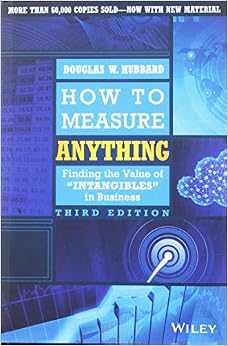
How to Measure Anything: Finding the Value of Intangibles in Business

Free Ebook How to Measure Anything: Finding the Value of Intangibles in Business
A book sometime acts as device to connect better and also smarter with other. A publication will also act as a standard as well as support of you to do something. A publication will certainly involve many experience as well as expertise to share to the others. This is just some of the advantages of a book. But, just how is the way to get those advantages? Obviously, guide will offer their advantage if you read them. So, a book doesn't should only display on the shelves or overdo the table. They have to read.
Why should be this book? This is exactly how the book will certainly be referred. It is really provided to overcome the knowledge and also ideas from guide. During this time around, it is in the listing of excellent books that you will certainly discover in this world. Not just the people from that nation, lots of international individuals additionally see as well as get the representative details and also ideas. How To Measure Anything: Finding The Value Of Intangibles In Business is what we need to try to find after getting the kinds of guide to require.
Supplying the ideal publication for the ideal procedure or problem can be a selection for you that actually wish to take or make handle the possibility. Reading How To Measure Anything: Finding The Value Of Intangibles In Business is a manner in which will certainly overview of be a much better individual. Even you have not yet been a good person; at the very least learning to be far better is a must. In this instance, the problem is out your own. You need something new to urge your readiness truly.
Generating the abilities as well as experiences of somebody will include just how you have acquired the benefits and qualities of How To Measure Anything: Finding The Value Of Intangibles In Business You may not feel overwhelmed the best ways to get it. This is the soft file system of book that you could get as your choice. In this problem, you need to sustain yourself to be somebody better. It can be done by reviewing it gradually yet indeed. Conserving the soft data in gadget and also laptop computer tool will certainly enable you open it almost everywhere.
This insightful and eloquent book will show you how to measure those things in your own business, government agency or other organization that, until now, you may have considered "immeasurable," including customer satisfaction, organizational flexibility, technology risk, and technology ROI.
Written by recognized expert Douglas Hubbard—creator of Applied Information Economics—How to Measure Anything, Third Edition illustrates how the author has used his approach across various industries and how any problem, no matter how difficult, ill defined, or uncertain can lend itself to measurement using proven methods.
Product details
Hardcover: 432 pages
Publisher: Wiley; 3 edition (March 17, 2014)
Language: English
ISBN-10: 9781118539279
ISBN-13: 978-1118539279
ASIN: 1118539273
Product Dimensions:
5.9 x 1.2 x 8.9 inches
Shipping Weight: 1.6 pounds (View shipping rates and policies)
Average Customer Review:
4.5 out of 5 stars
157 customer reviews
Amazon Best Sellers Rank:
#22,877 in Books (See Top 100 in Books)
This was a required text for a class for my Masters of Science in Organizational Leadership. I was terrified-I thought this was a statistics course. I had nothing to fear. This guy is a genius. The formulas he has developed to measure things that you would assume are impossible to measure are amazing. You don't need to know math-the equations are in the excel spreadsheets you download! Think of something you don't think you could measure. You can measure it, and this book shows you how. Very interesting and understandable, even for a math dummy like me.
My Ph.D. coursework revolved around advanced quantitative methods, and therefore I did consider many real-world things to be immeasurable. Indeed, lots of practical cases involve small sample sizes, a large number of factors that can influence the outcome, and many other sources of uncertainty. Such problems are not very amenable to advanced quantitative methods. They may appear absolutely hopeless, but not if you switch to the decision making framework described in this book.One simple idea is that, as long as the experiment reduces the costly uncertainty by the amount that is larger than the cost of research, it is worth performing. For instance, many experiments that may appear meaningless to a "classical" statistician because of their small sample size can be well justified once the benefit of uncertainty reduction is taken into account. The flipside is that if a study is well funded, well designed and replicated from the statistical viewpoint, it can still be useless. If our goal is to reduce the uncertainty to below a pre-specified threshold, then the "statistically" large sample size may still be unable to do the job. If the study is too expensive compared to the value of reduced uncertainty, it is not worth doing either. Another negative scenario is when we invest resources into measuring a variable that would make a small contribution to the uncertainty of the final outcome even if we knew the exact distribution of the variable.The book provides numerous examples that would be hard to crack for a "classical" statistician, and yet they are very amenable to the Applied Information Economics method developed by Mr. Hubbard. I can highly recommend it to all who "do not believe in statistics", as well as to the young quantitative analysts who want to expand the set of applications they can handle successfully.
Highly recommended.Most capital investments are poorly analyzed. Doug Hubbard provides remedies for the common shortcomings: o Typical cost-benefit analyses use single-value best estimates for inputs; these ignore or inadequately address risk and uncertainty. Also, often, important benefits are omitted because they are "intangibles" such as "improved customer service." Remedies in the book: Capture expert judgments as probability distributions; then solve the forecast model with Monte Carlo simulation. Decompose and explicitly represent former-intangibles in measurable units. o Multi-criteria scoring approaches often feel good yet have little theoretical foundation. They are entirely subjective and have not been shown to improve decision-making. Remedy: clarify the business (or other) objective and craft a quantified decision policy accordingly. Judge and/or model inputs in meaningful, quantitative terms.Everything important to a decision should be in a forecasting model. And everything in those models is either structural or quantified.For me, three primary themes emerge in the book:1. Calibration. Hubbard asserts that everything can be quantified--and he enjoys challenging individuals and groups to find any exception. Most people, even if expert in their field, are biased when making judgments. Hubbard shows ways to "calibrate" these experts (including the reader) with perhaps a half-day of practice. Most readers (as did I) will find that they initially fare poorly on the engaging calibration exercises in the book. We suffer from overconfidence and other cognitive biases. With feedback and practice, most people can quickly improve at assessing probabilities and probability distributions, and confidence ranges.2. What needs to be measured further? The most interesting calculation in the book is a form of sensitivity analysis. Which variables are most important to measure further? Hubbard calculates the value of perfect information for each variable with a straightforward expected opportunity loss calculation. Though an analysis may have dozens of identified variables with uncertainty, in his experience typically only 1 to 3 variables are worthy of further measurement.3. Deliberately seek information about the most-important risks and uncertainties where the additional time and cost are justified. This usually means obtaining more data with targeted investigation. Hubbard offers these encouraging maxims: o It has been done before o You have more data than you think o You need less data than you think o It is more economical than you thinkAdditional highlights of the book include: o Abundant war story examples. Much of Hubbard's work has been in the information technology (IT) sector. I especially enjoyed the case about forecasting fuel consumption for the U.S. Marine Corps. o Demystifying parameters that the reader might initially think as "intangibles." For example, "Improved Customer Service" might be measured in terms of percent of customers re-ordering; percent of returns; average delivery time, etc. o Example calculations, all done with Microsoft® Excel. He hosts a website, [...], where the reader can download example calculation worksheets, additional calibration quizzes, papers, articles, and reader comments.The first edition is excellent. Upon learning of a second edition, I immediately bought the updated book for a fresh re-read. This was again a good investment of time and money. The new edition is updated, expanded (about 15%), and more crisp. The editing and layout are again excellent. Several references are now embedded to his other best-selling and companion book, The Failure of Risk Management.
How to Measure Anything: Finding the Value of Intangibles in Business PDF
How to Measure Anything: Finding the Value of Intangibles in Business EPub
How to Measure Anything: Finding the Value of Intangibles in Business Doc
How to Measure Anything: Finding the Value of Intangibles in Business iBooks
How to Measure Anything: Finding the Value of Intangibles in Business rtf
How to Measure Anything: Finding the Value of Intangibles in Business Mobipocket
How to Measure Anything: Finding the Value of Intangibles in Business Kindle